Demon Slayer cosplay is still one of the most common sights at any anime con, and that’s no accident. Demon Slayer has characters with super-clear silhouettes, traditional Japanese patterns you can recognize from across the hall, and a base uniform that almost the whole cast shares. That means a good haori and a well-styled wig already get you halfway there.
In this guide we go through the five characters people look up most for cosplay (Nezuko, Mitsuri, Shinobu, Tanjiro and Zenitsu), what each one needs, how to tackle the haori and its pattern, and when it makes sense to buy the costume versus make it yourself.
Demon Slayer cosplay: the base almost everyone shares
Before you pick a character, it helps to understand how the outfits are built. Most demon slayers wear the Corps uniform: a dark, high-collared jacket with buttons, a white belt and wide hakama-style pants gathered at the calf with white or colored leg wraps (kyahan). The back carries the kanji 滅 (metsu, “destroy”). Over that, each character wears their own haori, the traditional open-front Japanese jacket, and that’s what really makes them recognizable.
This is a huge practical advantage. Once you own a uniform, you can switch characters by swapping just the haori, the wig and the sword. A lot of cosplayers get two or three looks out of the same base over a con season.
- Footwear: zori (Japanese sandals) with tabi socks. If you’ll be on your feet all day, simple black sneakers or cushioned insoles will save you.
- Wigs: nearly every character has color-fade tips. Get heat-resistant fiber if you plan to style it with a flat iron or blow dryer.
- Katanas: always foam, lightweight PVC or balsa wood, never metal. We cover convention rules further down.
A quick word on tone. Tanjiro, Nezuko and Zenitsu are teenagers in the story, so the natural approach is to treat their cosplay as exactly what it is, a tribute to the character, with no spicy takes. If you want ideas for other characters and styles, our guide to easy anime costumes has plenty more options.
Nezuko cosplay: pink kimono and bamboo muzzle
Nezuko is one of the series’ signature looks and a go-to pick for a first Kimetsu no Yaiba cosplay. It’s easy to see why: her outfit is gorgeous and instantly recognizable.
What goes into a Nezuko cosplay
- Light pink kimono with an asanoha (hemp leaf) pattern, a geometric motif of six-pointed stars. It was traditionally linked to good health and protection from evil, which is why babies were dressed in it.
- Red and white checkered obi, narrower than a formal obi, with an orange cord (obijime) and a light green sash peeking out above it (obiage).
- Long dark brown haori that hangs nearly to the calf.
- Small pink ribbon on the left side of her head.
- Bamboo muzzle held in place with a strip of red fabric.
- White tabi socks, black leg wraps and zori with pink straps.
Wig and makeup
Nezuko’s wig is long and black, styled in big defined waves, with flame-orange tips from about elbow length down. Store-bought versions usually come with the fade done, but if yours is plain black you can sew orange wefts in underneath or dye the ends with ink made for synthetic fiber. Set the zigzag waves with a flat iron on low heat and some hairspray.
Her eyes are pale pink. If you want colored contacts, get them from an eye care professional with a valid prescription, stick to the recommended wear time and never share them. Novelty lenses sold without any oversight can damage your cornea, and no cosplay is worth that. Without contacts, soft brown and pink liner is enough to soften your look.
Making the bamboo muzzle without misery
Her most iconic accessory is also the most annoying to wear. Your best options are a thin piece of sanded bamboo, or a PVC or cardboard tube painted to match and cut in half lengthwise so it stays light. Tie the red fabric behind your head with a loose knot or attach it with Velcro. It should never squeeze your jaw or make breathing harder, and take it off to eat, drink or wait in long lines. You can pop it back on for photos in two seconds.
Mitsuri Kanroji cosplay: pink and green braids
Mitsuri, the Love Hashira, is the favorite for anyone who wants a cheerful, colorful character. The main challenge is the wig, which has a lot of personality.
The three-braid wig
Mitsuri’s hair is long and light pink, fading to lime green around the middle, and she wears it in three thick braids. Her bangs, cut into five uneven sections, also end in green. The easiest route is to start with a long pink wig and add green extensions (clip-in or sewn) before braiding. Her eyes are light green and she has a small beauty mark under each one, which you can add with brown eyeliner.
The uniform and accessories
Mitsuri wears a heavily modified uniform in a dark shade with a plum tint, open at the chest, with a short pleated skirt instead of hakama and long navy stockings over green vertically striped ones, a gift from Obanai. On top goes a plain white haori, and on her feet, white zori with pink straps and bows.
Many cosplayers fill in the neckline with a camisole or a bodysuit in the same color as the uniform, especially for long or outdoor events. That’s a totally valid comfort call, and the character still reads instantly thanks to the wig and the colors.
Her sword is a paper-thin, flexible pink blade, almost a whip, with a magenta handle and a four-leaf-clover guard. For a con, a thin strip of painted EVA foam or a stiff band of flexible plastic gives you the effect without putting anyone at risk.
Shinobu cosplay: the butterfly haori
Shinobu Kocho’s cosplay is one of the most elegant in the series, and nearly all the work goes into a single garment.
What you’ll need
- Black uniform with a slight purple tint and gold buttons, plus black hakama tucked into butterfly-decorated wraps.
- White haori with a butterfly-wing pattern on the sleeves and hem, fading from turquoise to pink. The cuffs have a trim of black and white dots.
- Wig at shoulder length, black fading to dark purple, pulled into a low bun and held with a white and purple butterfly ornament.
- White sandals with purple straps.
Shinobu’s eyes are violet with no visible pupils, which is a tough detail to pull off. If you’d rather skip contacts, a soft lilac shadow on the lids and a calm expression do more than any accessory, because that serene smile is part of who she is.
The stinger sword
Her sword isn’t a regular katana. It has a standard handle, but the blade is narrow, lavender blue, and ends in a fine stinger-like point. The guard is shaped like a four-petal flower. Make it from foam with a rounded, flexible tip, because a sharp point, even a plastic one, can hurt someone in a crowd.
Tanjiro cosplay: green checks and hanafuda earrings
Tanjiro cosplay is the perfect entry point: the parts are easy to find and the result is recognizable at a glance.
- Checkered haori in black and teal green, the famous ichimatsu pattern, which in Japan is associated with prosperity and continuity.
- Dark gakuran-style uniform, white belt and white calf wraps.
- Hanafuda earrings, small plates with a red design on a white background. You can make them from laminated cardstock or polymer clay and mount them on clip-ons if your ears aren’t pierced.
- Wig: short and a little messy, black with burgundy tips.
- The scar on the left side of his forehead, painted with dark red makeup or built up with special-effects latex. If you use adhesives or latex, patch test a small area of skin first to rule out allergies.
- Zori with red straps and tabi socks.
The wooden box
If you want to go the extra mile, the box Tanjiro carries on his back (where Nezuko rides) is the accessory that gets the most photos. To keep it from wrecking your back, build it from foam board, thick EVA foam or very thin plywood, and strap it on with backpack straps hidden under the haori. If you’re doing a pair cosplay with a Nezuko, that photo is guaranteed. For more ambitious builds, OtakuOshi has prop makers who share their process.
His katana is black with a round, wheel-shaped guard early in the story, and later gets the flame-shaped guard he inherits from Rengoku. Pick the version that matches the arc you’re going for.
Zenitsu cosplay: the yellow triangle haori
Zenitsu Agatsuma has a big fan base, and his cosplay is simple enough to earn a spot on your list. His signature is a haori that fades from yellow to orange with a repeating pattern of white triangles, inspired by the traditional uroko (scales) motif.
- Uniform in a golden brown shade, with a white shirt underneath and a white belt.
- Calf wraps in yellow and orange with the same white triangles and three white bows in front.
- Wig: short and blond, cut in uneven chunks with orange tips.
- Katana: black with yellow lightning running along the blade, a yellow handle and a white sheath.
Zenitsu’s eyebrows are gold and forked, a detail that really shows in close-up photos. Block out your own brows with a glue stick and powder or a brow concealer, then draw his on top with yellow and orange shadow. And if you want to nail the character, practice both of Zenitsu’s faces: the comic panic one, and the focused, eyes-closed one from the moment he draws his sword.
The haori: pattern and print
If you only sew one piece, make it this one. A good haori makes any Kimetsu no Yaiba cosplay look more polished, even if the uniform underneath is basic.
A pattern made of rectangles
The good news is that a haori is built almost entirely from rectangles, just like a kimono. You need two back panels (joined by a center seam), two front panels, two wide sleeves and a long collar band that runs the full length of the front opening. Some patterns add side gussets (machi) for extra ease. The length depends on the character: Tanjiro’s hits mid-thigh, while Nezuko’s is much longer.
Measure your chest and arm length before cutting, and leave some room. A haori should hang loose; if it’s snug, it loses its drape. If it’s your first garment, sew a test version in cheap fabric first. The tutorials and templates section on OtakuOshi has creators who post patterns and step-by-step process content.
Recommended fabrics
Cotton poplin or a lightweight twill is the most forgiving choice to start with, because it presses well and takes fabric paint nicely. Polyester is a must if you plan to sublimate the print. Avoid very thin or sheer fabrics, which wrinkle and let the uniform show through.
Four ways to get the print
- Pre-printed fabric: the checkerboard and asanoha are traditional Japanese motifs, so fabric with them is fairly easy to find at fabric stores or online. You’ll just need to adjust the scale and colors.
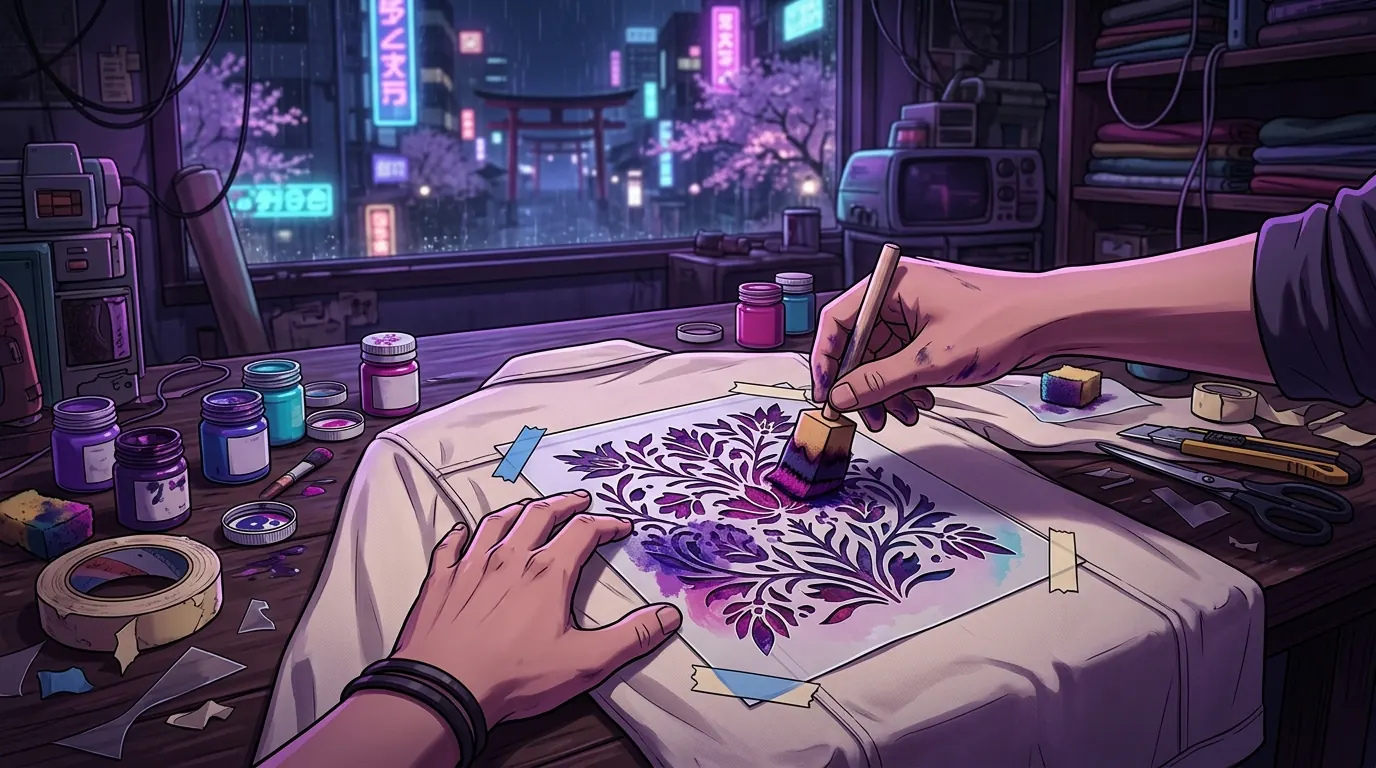
- Fabric paint with a stencil: for Tanjiro’s checks, mark the grid with masking tape and paint every other square. For Zenitsu’s triangles, cut a stencil out of acetate. Heat-set the paint with an iron following the manufacturer’s instructions.
- Heat transfer vinyl (HTV): great for clean geometric shapes. Cut it by hand or with a cutting machine and iron it on.
- Painted gradients: Shinobu’s wings and Zenitsu’s yellow-to-orange fade come from thinned fabric paint applied with a spray bottle or airbrush, in thin layers with drying time in between.
In Japan, Shueisha, the manga’s publisher, tried to trademark the haori patterns. In 2021 the Japan Patent Office rejected Tanjiro’s, Nezuko’s and Zenitsu’s as traditional motifs that are too common, while it accepted Giyu’s, Shinobu’s and Rengoku’s. For your personal cosplay nothing changes, but if you ever plan to sell haori, look into the intellectual property rules first.
Buy a Demon Slayer costume or make your own?
It comes down to your time, your budget and how you plan to use the outfit.
When buying makes sense
Demon Slayer costumes have been sold for years at Halloween stores, cosplay shops and online marketplaces, so there’s no shortage of options. Buying a Demon Slayer costume makes sense if it’s your first cosplay, if your con is coming up soon or if sewing just isn’t your thing. Before you pay, check:
- The size chart in actual measurements, not just the letter size. Many costumes use Asian sizing, which tends to run small.
- Real photos from buyers, not just the product shots.
- What’s included. The wig, sword and shoes are almost always sold separately.
- The fabric. A haori that’s too shiny or too thin really shows in photos.
If you’re after merch rather than a con costume, go for officially licensed products, which usually show the series copyright on the tag or packaging.
When making it makes sense
Making your own Demon Slayer cosplay gives you control over fit, colors and quality, and it lets you enter cosplay contests, where many rules reward or require handmade work. Always read each contest’s rules before signing up. It’s also the most satisfying route, though it takes more hours than you’d think.
The hybrid approach
What most cosplayers with some experience do is buy the base uniform, which is a fairly standard garment, and handmake the haori, the accessories and the wig styling. That way your effort goes where it shows most. If you want to compare with other characters by difficulty, our list of cosplay ideas for women and men has 30 easy picks to compare.
Convention prop rules
Katanas are the tricky part. At Anime Expo in Los Angeles, for example, cosplayers carrying a prop weapon have to take it to Weapons Check for peace bonding, and props can’t be more than 7 feet in any direction. Every US con sets its own policy, sometimes with a prop check at the door, so read the official site before you go. And never draw your katana from its sheath in a crowd.
One last tip before the con: for reliable references, go to the source material. The complete manga runs 23 volumes. If you’re planning a look from Infinity Castle, the first film of the trilogy came out in 2025, and at the time of writing the second part had no official release date, so keep an eye on the series’ official channels in case it’s been announced.
Demon Slayer cosplay FAQ
Which Demon Slayer character is easiest for beginners?
Tanjiro is usually the simplest, because his checkered haori is easy to find and the short wig gives you very little trouble. Zenitsu is right behind him. Nezuko and Mitsuri need more wig work, and Shinobu depends a lot on how you handle the haori gradient.
How long does it take to make a haori?
It depends on your experience and the print. Sewing the garment itself is fairly quick since it’s all straight pieces, but hand-painting the checks or triangles can take several sessions once you factor in drying time. If you have a con coming up, start with the haori and leave the accessories for last.
Can I bring a katana to a convention?
Generally yes, as long as it’s a lightweight replica made of foam, plastic, cardboard or soft wood and it follows the event’s rules. Metal or sharpened weapons are usually banned. Some cons inspect props at the entrance and may ask you to check them.
Are colored contact lenses safe for cosplay?
Only if they’re prescribed and fitted by an eye care professional and you wear them as directed. Don’t buy them from sellers with no guarantees, don’t sleep in them and don’t share them. If you feel any discomfort, take them out and see a specialist.
Can we do a Demon Slayer group cosplay?
It’s one of the best group options out there. Tanjiro, Nezuko, Zenitsu and Inosuke make up the classic squad, and the Hashira work for a big group with very different outfits. Agree on which part of the story you’re doing so the uniforms and swords match.
Share your Demon Slayer cosplay on OtakuOshi
Every hand-painted haori and every three-braid wig takes hours of work that deserve to be seen. On OtakuOshi, cosplayers and prop makers share their process, photo shoots and tips with the people who want to follow along. You can sign up for free, support the creators who inspire you and, once your outfit is ready, post your own Demon Slayer cosplay too.
Sign up for our newsletter
We'll email you whenever we publish something new.