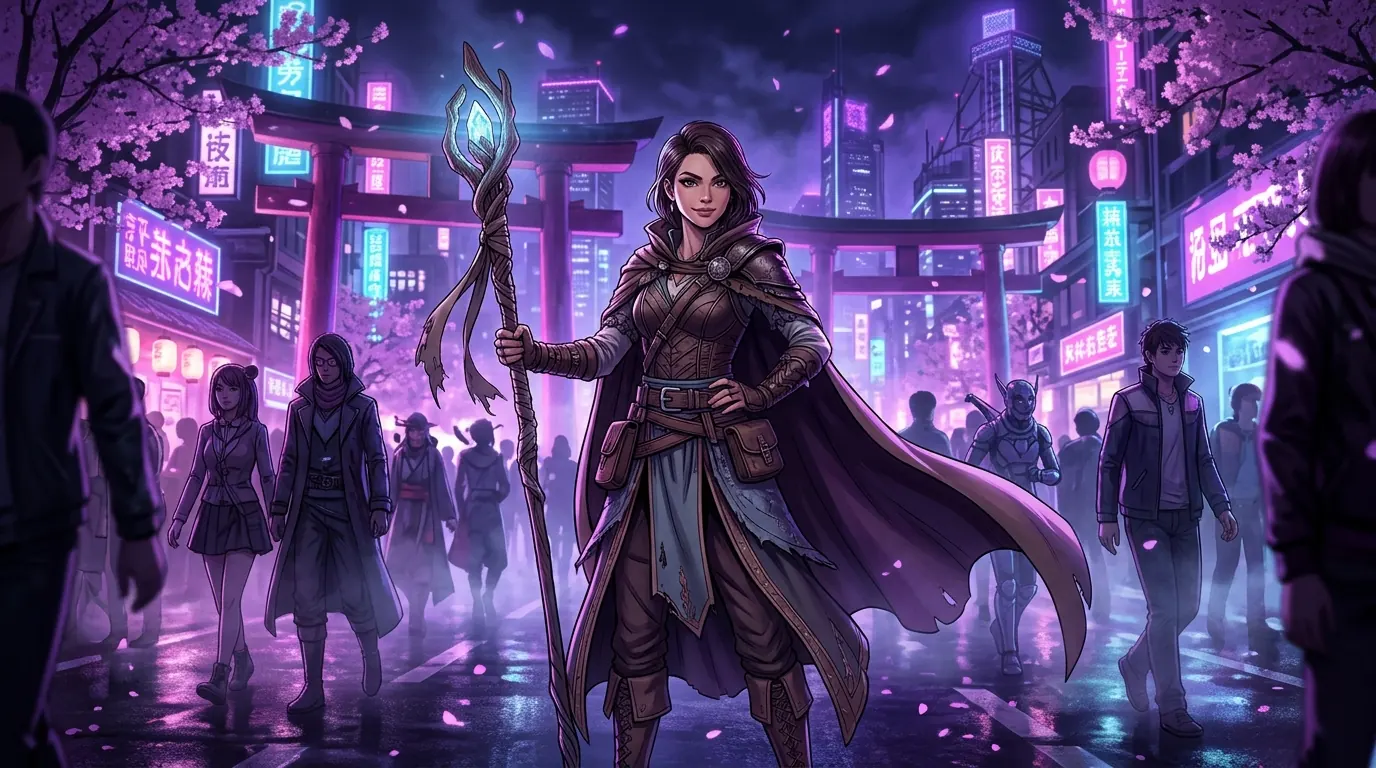
Walk past ExCeL on an MCM weekend and you could well see Demon Slayer swordsmen queuing for the DLR next to armoured Space Marines, which is about as good a demonstration as you’ll get. But if you want it in words, what is cosplay? It’s the craft of becoming a fictional character, most often one from anime, manga, games, comics, film or TV, by wearing their look and acting the part. Underneath that tidy definition sits a whole toolbox of skills (tailoring, foam armour, wig styling, make-up, posing for the camera) and a fan scene that has been growing at conventions since 1939.
Below we unpack the word itself, look at what cosplayers get up to, trace the hobby back to its surprisingly American roots and run through the styles people talk about. Stick around to the end for a beginner’s plan that keeps costs sensible and frustration low.
What is cosplay? The meaning behind the word
Strictly speaking, “cosplay” is Japanese-made English. Take costume, add play, then do what Japanese does to lots of loanwords and chop each one down to its first chunk. The result was コスプレ, pronounced kosupure, which English speakers later borrowed straight back as cosplay. A round trip, in other words.
If you had to squeeze the idea into a sentence, it would be “playing a character by way of their outfit”. People tend to underrate the playing. Pulling on the clothes is step one; the rest is inhabiting the role, from the way a character stands to the face they pull, and at a masquerade or contest it can stretch to a fully staged performance.
Isn’t that just fancy dress?
There’s overlap, but Brits who grew up with fancy-dress parties will spot the difference quickly. Fancy dress is usually generic (a vampire, a nurse, a caveman), picked up from a supermarket aisle or cobbled together for one evening. Cosplay aims at a particular named character, and the satisfaction comes either from nailing every detail or from a deliberate reinterpretation. Builds routinely take weeks, sometimes months, and the costume then lives at cons, photoshoots, competitions and on Instagram rather than at a mate’s Halloween do.
Still, there’s no gatekeeper checking credentials at the door. Wearing a shop-bought outfit to a con because you love the character counts. The edges are fuzzier than some purists like to admit.
So what exactly is a cosplayer?
A cosplayer is simply someone who cosplays, whatever their gender. Japanese fans long used the clipped form reiyā (from “layer”, the tail end of cosplayer), though you’ll rarely hear it these days; kosupureyā or plain “cosplayer” has taken over.
Beyond the definition, it’s a broad church. At one end are people who dress up a few weekends a year purely for the joy of it; at the other are full-time makers, the kind of cosplayers who live off commissions, workshops, pattern sales or content their fans pay for. Somewhere in the middle you’ll meet photographers who never wear a costume, competitors who live for the stage, and groups of friends who mostly go for the day out.
What cosplayers tend to have in common
Personalities vary wildly, yet a handful of habits show up in almost every corner of the scene:
- A favourite they can’t let go of. The spark is nearly always affection for one character, and wearing them is a way of showing it.
- DIY skills learnt on the job. Few people start out able to sew or sculpt, but give it a costume or two and you’ll be warming EVA foam with a heat gun and sanding seams like a pro.
- Near-forensic attention to detail. Is the wig ash blonde or platinum? Does the cloak drape or swing? Screenshots get paused, zoomed and argued over.
- A bit of a performer. Practising a signature pose or expression in the mirror before a shoot or contest is completely standard.
- A sharing mindset. Patterns, failed experiments and supplier tips get passed around freely, and turning up as an entire cast with your friends is half the fun.
And it’s worth saying loudly that the community spans all ages, shapes, genders and backgrounds, and nobody needs to resemble a character to wear them.
Where cosplay began: an American hobby with a Japanese name
Here’s the twist many fans don’t expect. Although the label is Japanese, costuming at fan conventions was born in the US sci-fi scene. Taking the timeline in chunks makes it easier to follow.
1939: Ackerman, Morojo and the “futuristicostumes”
Most histories point to New York and the very first Worldcon, the World Science Fiction Convention, in 1939. Two fans arrived in outfits from the future: Forrest J Ackerman and Myrtle R. Douglas, better known in fan circles as Morojo, who had designed and stitched both costumes. Their name for them was futuristicostumes. Masquerade contests quickly became a staple of US conventions after that, and by 1974 San Diego Comic-Con was staging its first Masquerade.
Meanwhile in Japan (1975–1980)
Comiket, the enormous Tokyo marketplace for self-published comics, opened its doors in December 1975 and in time turned into one of the great stages for costume fans. Three years later, at the Ashinocon gathering in Hakone, Mari Kotani appeared in an outfit modelled on the cover art of an Edgar Rice Burroughs book; that 1978 appearance is widely treated as the earliest documented costume at a Japanese fan event. By 1980, the Nihon SF Taikai (Japan’s national science-fiction conventions) were holding costume contests as a matter of course.
1983: the word “cosplay” arrives
Credit for the term goes to Nobuyuki Takahashi of Studio Hard, a studio that also published. Writing in My Anime magazine in June 1983, he reached for a new word because the Japanese translation of “masquerade” felt fusty and grand to him. A lot of websites repeat the tale that he dreamt it up after a trip to the 1984 Los Angeles Worldcon; it’s everywhere, yet an article from the previous year rather spoils it. It’s fair to say, though, that fans needed a couple of years to start using the word.
Japanese cosplay then went its own way, bound up tightly with anime and manga (and with the fans who call themselves otaku). During the 90s and 2000s it swung back towards the West on the back of the internet, a boom in anime conventions and the spread of anime far beyond Japan.
Team UK and the World Cosplay Summit
For a sense of scale, look at the World Cosplay Summit. It began in Nagoya in 2003 with a mere five guest cosplayers, and in 2005 it added a championship in which pairs compete for their countries. British fans have a reason to follow it closely: in 2023 Team UK were crowned Grand Champions, with Latvia second and Mexico third. These days the UK’s representatives are chosen at MCM London Comic Con, and the qualifier for the next final was held on 24 October 2026. That final has shifted to the autumn and is due in Nagoya in November 2027, so keep an eye on the World Cosplay Summit’s official website if you’re tempted to enter.
The main types of cosplay
With the basic meaning of cosplay sorted, it helps to know the jargon for different approaches. Nobody has published an official taxonomy, but you’ll hear these terms constantly, and a single costume can tick several boxes.
Screen-accurate, or “canon”, cosplay
This is what most people imagine first. The goal is a perfect match with the source material: same garments, same hairstyle, same accessories, same colours. Precision is everything, which is why high-level competitors usually head in this direction, frequently with every seam and prop made by hand.
Crossplay
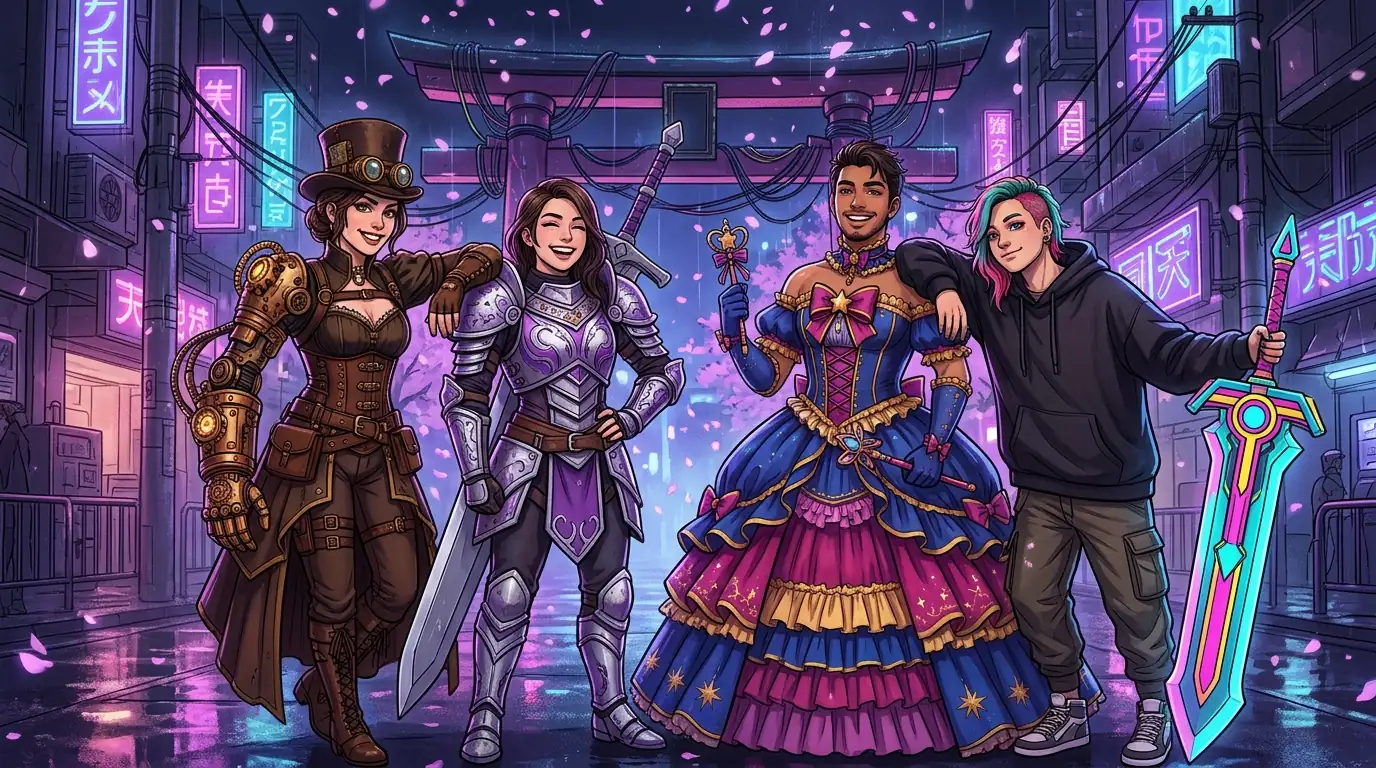
Here you portray a character whose gender differs from yours, without changing their design. A woman suiting up as a ronin, a man in a magical girl’s ribbons and frills. Anime and manga are packed with androgynous designs, so nobody at a con bats an eyelid.
Genderbend
People confuse the two all the time. With a genderbend, the character themselves is reimagined as another gender, so you’d design a female version of a male lead (or vice versa) and redesign the costume around that. It’s a freer, more creative brief with plenty of space for original ideas.
Closet cosplay, or casual cosplay
The gentlest way to start. You raid your wardrobe, or a charity shop, for pieces that hint at the character: the right coloured hoodie, similar jeans, a single giveaway accessory. Accuracy isn’t the point; being recognisable and comfortable all day is.
More labels you’ll bump into
- Mashups and crossovers: two characters, or two franchises, fused into one outfit.
- Alternate takes: a familiar face transplanted into another setting, be it a Victorian steampunk twist, a neon cyberpunk look or a school-uniform version.
- OCs: original characters you’ve invented. Certain competitions won’t accept them, so check the entry rules.
- Armour and large props: more a speciality than a style, covering full armour builds, replica weaponry and 3D-printed components.
Prefer the workbench to the spotlight? See how cosplay prop makers share each build, from first sketch to final paint job.
Starting cosplay as a complete beginner
Don’t panic if you can’t sew or don’t own a garage full of tools. Going one step at a time, and being picky about project number one, makes far more difference.
- Choose someone you’re properly fond of. The hours add up, so pick a character you won’t tire of. First time round, favour simple outfits with few extras, such as a school uniform, everyday clothes or a single-colour suit.
- Build a reference board. Grab front, side and rear views, and any official art. Then ask yourself what makes the character instantly readable; usually it’s the hairstyle plus one or two key props.
- Split the shopping list from the making list. Making it all yourself isn’t compulsory. Lots of people buy a wig and base garments, then craft the details. Competition entrants should read the rules early, though: the MCM London qualifier for Team UK, for example, wants entrants to make their own costumes, while allowing shop-bought wigs, shoes and accessories that the entrant has styled or altered.
- Learn on budget materials. Craft foam, foam board and secondhand fabric are ideal for practice because mistakes cost pennies. Keep the room aired, wear a dust mask for sanding and spray paint, and be careful with craft knives and heat guns.
- Don’t neglect the wig or the make-up. Nothing improves a costume faster than a properly styled wig. Try any new cosmetic on a small patch of skin before going all in, and keep eye products to yourself. If coloured contacts appeal, get advice from an optician first and only wear lenses bought through proper channels, never someone else’s pair.
- Read the event’s prop and safety rules. Replica weapons and stage effects are restricted at most cons. As an example, the 2026 Team UK qualifier rules send entrants to ReedPop’s costume, weapons and props policy, mention security checks at the entrance, and rule out pyrotechnics, naked flames, lasers and glitter on stage.
- Wear it, and have fun. Pack an emergency kit with safety pins, double-sided tape and glue, plus a bottle of water. Perfection isn’t the aim with costume number one; it’s a lesson in what to change for number two.
To watch whole builds come together, head to the tutorials and templates section, where creators show how they solve each element, or scroll the finished results on OtakuOshi’s cosplay page when you need a nudge of inspiration.
Where to debut your first cosplay in the UK
Comic cons and anime festivals are the natural first outing. Top of most lists is MCM London Comic Con at ExCeL, every May and October, complete with a dedicated Cosplay Central area, and MCM also runs a show at Birmingham’s NEC, which in 2026 took place in August. In July 2026 Hyper Japan returned to Olympia London, an event that has included a cosplay show ever since it started. If you’re at MCM London, look out for the fan-run meets on Royal Victoria Square, by ExCeL. Schedules shift every year, so check official sites and social accounts before booking trains or hotels.
And a golden rule from your very first con: always ask before photographing someone, and keep your hands off people and their costumes unless they say yes. Back in 2014, New York Comic Con covered its halls with “Cosplay Is Not Consent” signs, a message that has travelled to events all over the world since.
Cosplay FAQs
What is cosplay, in a nutshell?
Bringing a character from fiction to life through costume and performance. The term is borrowed from Japanese kosupure, itself built from two English words, costume and play.
Who came up with cosplay?
Nobody single-handedly, but the habit grew up at American sci-fi conventions, with Forrest J Ackerman and Morojo at the 1939 Worldcon as the classic example. As for the name, that was Nobuyuki Takahashi’s doing, in a 1983 issue of the Japanese magazine My Anime.
Is a female cosplayer called something different?
No, English uses “cosplayer” for everyone, regardless of gender. Some treat it as a pastime; others make it pay through commissions, shoots or fan subscriptions.
Can I cosplay if I can’t sew?
Absolutely. A closet cosplay put together from your own wardrobe is a perfectly good start, as is modifying bought pieces. Stitching, foam crafting and painting improve with every project, and free tutorials from fellow cosplayers are everywhere.
Is cosplay expensive?
That comes down to the character you choose and how much of the work you do. Reusing clothes you own keeps a closet cosplay close to free, while a complete armour build or a showpiece ballgown can swallow months of evenings and a serious chunk of your materials budget. Begin with something modest and decide what you’re willing to spend before the first purchase.
Does it have to be anime characters?
Not at all. Anime and manga dominate at Japanese-culture events like Hyper Japan, but you’ll also see people dressed as video game heroes, Marvel and DC characters, film and TV favourites, figures from novels and even mascots from adverts.
Show off your cosplay on OtakuOshi
Got the basics of what cosplay is and fancy seeing how others approach it? OtakuOshi is home to cosplayers, prop makers and artists who post their costumes, behind-the-scenes progress and finished shoots for the people who follow them. Join OtakuOshi for free to follow and directly support the creators you rate, or open a creator profile of your own once you’re ready to share the journey from rough pattern to polished photo.
Sign up to our newsletter
We'll email you whenever we publish something new.