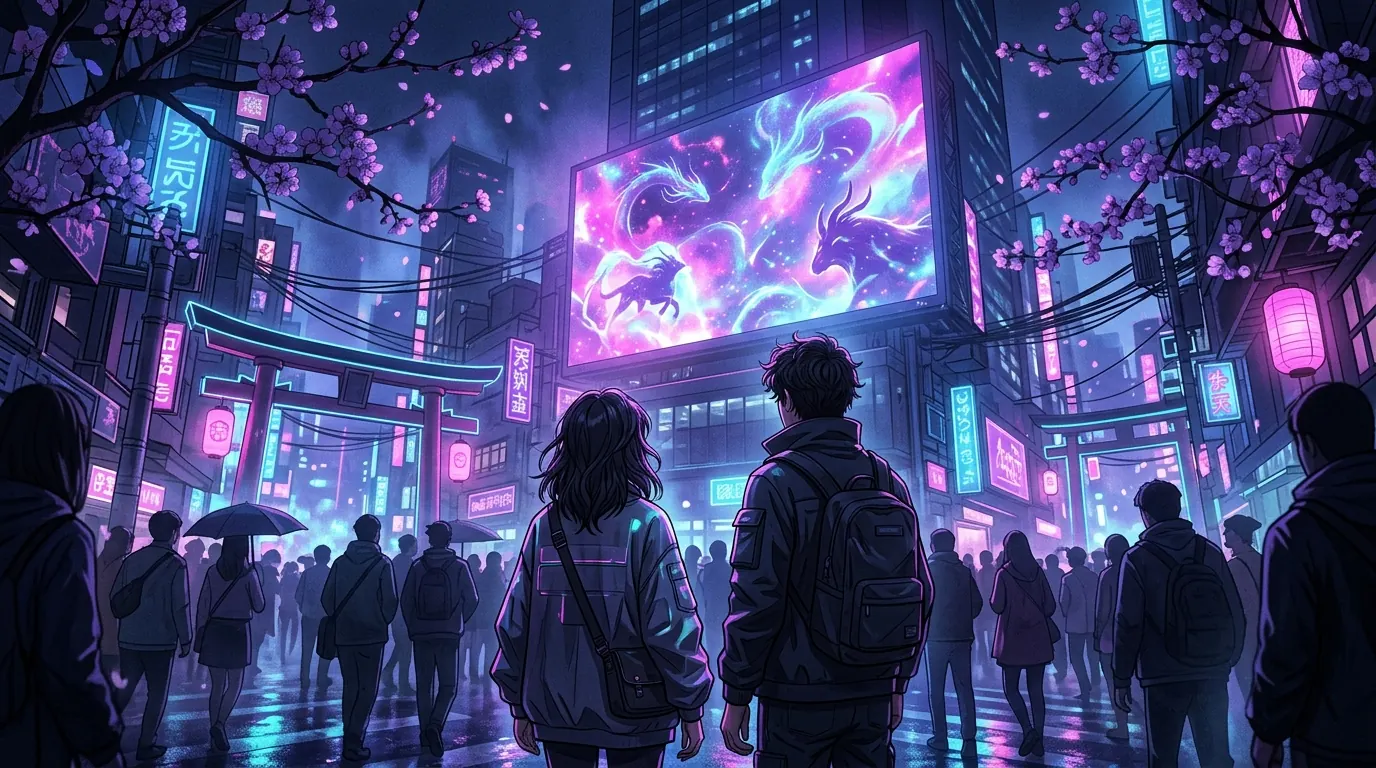
So, what is anime? Plenty of people would shrug and say “Japanese cartoons”, and they’d be half right. The short version is that anime means animation produced in Japan, an industry with its own business model, its own system for labelling audiences and genres that stretch from fluffy high-school comedy to grim historical war stories. The longer version is more fun, because it shows why the cheerful robot cat of Doraemon and the Viking bloodshed of Vinland Saga can share a label while having almost nothing else in common.
This guide walks through the origins of the word, how anime relates to manga, the audience groups Japanese publishers use, the genres that fill streaming menus, the art styles you’ll learn to tell apart and some easy first watches for newcomers.
What is anime? The word and its roots
Japanese took the English word animation, turned it into アニメーション (animēshon) and then chopped it down to “anime”. A popular theory traces it to the French phrase dessin animé, though most references dismiss that as folklore. Japanese speakers apply the word to any animated work at all, so a Pixar film is anime in Tokyo. Outside Japan, Britain included, it refers specifically to animation that comes from Japanese studios.
A broader camp argues anime is really a style, one that a studio in Seoul, Paris or Manchester could produce. That debate rumbles on, but when most of us hear the word we still think of series and films made in Japan.
From 1917 to a global industry
The oldest Japanese animation that can be reliably dated comes from 1917. Of the films released that year, Namakura Gatana, which first screened in June and is known in English as The Dull Sword, is the oldest still in existence. Historians generally name three pioneers as the fathers of the art form: Ōten Shimokawa, Seitarō Kitayama and Jun’ichi Kōuchi.
Proper industrial scale came after 1945. Toei put out Hakujaden in 1958, the studio’s first colour feature-length animation. On New Year’s Day 1963, Fuji TV broadcast the opening episode of Osamu Tezuka’s Tetsuwan Atom, better known here as Astro Boy, produced by his company Mushi Production. Its recipe of one episode a week, shoestring budgets and stories lifted from popular manga still shapes television anime today.
From there the milestones pile up. Dallos became the first OVA in 1983; Akira made waves around the world in 1988; and Spirited Away took home an Academy Award in 2003, convincing a lot of Western audiences that this was not merely children’s entertainment. The industry is now enormous. According to the Association of Japanese Animations (AJA), whose most recent report came out in early 2026, the market hit a record of around ¥3.84 trillion in 2024, and overseas sales had overtaken the Japanese market itself.
Formats you’ll come across
- TV anime: by far the most common. A typical season is 12 or 13 instalments, each roughly 24 minutes long, and fans often call a three-month block a “cour”.
- Feature films: these include movie spin-offs of TV hits as well as personal projects from directors like Makoto Shinkai or the team at Studio Ghibli.
- OVA (original video animation): produced for the home-video shelf rather than broadcast, which tended to mean looser creative rules and more money spent on each minute.
- ONA (original net animation): premiered on the internet or a streaming platform before anywhere else.
Interested in the craft itself? Independent animators post their reels and short films in OtakuOshi’s anime animation section.
Anime vs manga: how they differ
No mix-up is more common among new fans, and any honest answer has to pull the two apart early. Think of manga as Japan’s comics, on paper or on screen, laid out right to left and usually released a chapter at a time in anthology magazines, then bundled into volumes. Anime takes a story and animates it, adding movement, actors’ voices, music and editing.
Lots of anime begins life as manga, but far from all of it. Light novels, games and visual novels are frequent sources, and a good number of shows are original scripts written for TV or film. Every so often the manga is the spin-off, arriving after the animated version.
Adapting a manga that hasn’t finished yet carries a risk: the anime can run out of story. Studios then have a choice between taking a break, filling time with filler episodes or inventing an ending of their own. The 2003 Fullmetal Alchemist series did the latter and wandered off from its source, before Fullmetal Alchemist: Brotherhood (2009) went back and followed the manga closely. It’s the reason fans so often say that the manga is where you’ll find the author’s complete vision. If that appeals, have a browse of our doujin and manga section, where independent creators publish their comics.
Types of anime: who it’s made for
This is where a lot of newcomers get tangled up. When people list types of anime, they’re usually naming demographics, not genres. The terms come from Japan’s manga magazines, each of which targets readers of a particular age and sex, and an anime normally inherits the label of the magazine that serialised its manga. It describes the intended reader, not the actual audience, which is often far wider.
Kodomo
Children’s anime: straightforward stories, warm-hearted jokes and an obvious lesson by the end. Think Pokémon or Doraemon. Publications like CoroCoro Comic have catered to this age group for decades.
Shōnen
Literally “young boy”, it’s aimed at teenage boys but watched by pretty much everyone, and it’s the category with the biggest following outside Japan. Its favourite themes are loyalty between friends, effort, beating the odds and lots of battles or competitions. Its flagship, Weekly Shōnen Jump, sold an average of roughly 985,000 print copies an issue in April to June 2026, dropping below one million for the first time even as digital reading kept growing. Titles as different as Frieren, Haikyu!! and Spy x Family all fall under shōnen, which tells you how elastic it is.
Shōjo
The teenage-girl counterpart. Emotions, friendships, romance and coming of age take centre stage, often mixed with fantasy, adventure or a mystery to solve. Fruits Basket and Sailor Moon remain classic entry points.
Seinen
Targeted at men from their late teens upwards, seinen has room for heavier subjects, bloodier violence, morally murky heroes and a more patient rhythm. Compare the quiet, almost meditative Mushishi with the sprawling Vinland Saga to see both ends.
Josei
For grown women. Josei handles relationships, jobs, everyday routine and adulthood with more realism than shōjo usually does. Good animated examples include Honey and Clover and Chihayafuru.
Checking which group a show belongs to gives you a fair hint about its mood. Treat it as a rough guide rather than gospel.
The most popular anime genres
On top of the demographic comes the genre, just as with live-action film and TV. Nothing stops a show being both shōnen and a sports drama, or seinen and sci-fi. You’ll meet these genres again and again in streaming categories and fan recommendations.
- Action and adventure: quests, duels and grudges, where shōnen feels most at home.
- Mecha: people climbing into towering robots. Distinctly Japanese, and capable of anything from blockbuster thrills to existential drama.
- Isekai: a main character gets transported to, or reborn in, a different world that often works like an RPG. Over the last ten years it’s taken up a remarkable share of new shows.
- Slice of life: low-stakes stories about daily routines. A subgenre called iyashikei, or “healing” anime, exists purely to soothe you.
- Romance: covering teenage romcoms at one end and mature love stories at the other.
- Sports, or spokon: volleyball, football, basketball and even competitive karuta, with team spirit and graft powering the plot.
- Science fiction and cyberpunk: bleak futures, thinking machines and sprawling neon cities, with Akira still the reference point.
- Psychological and horror: dread, puzzles and battles of wits. For most viewers, Death Note is the gateway.
- Fantasy: spells, imaginary lands and monsters. Frieren won huge acclaim for giving the genre a reflective, melancholy spin.
- Mahō shōjo, or magical girls: young heroines who change form to battle villains, a formula Sailor Moon defined.
- Comedy: anything from surreal silliness to parodies poking fun at anime tropes.
Don’t be thrown when a streaming service lists demographics and genres side by side in one filter. Seeing “shōnen” beside “horror” isn’t a glitch; they simply measure different things.
Anime styles you should be able to spot
Ask a non-fan to describe anime and you’ll hear “huge eyes and rainbow hair”. That’s certainly common, but anime styles vary far more than the cliché suggests. The thread that runs through nearly all of them is limited animation: rather than keeping every element moving, animators animate only what the shot needs and invest in strong drawings and framing instead. It’s why anime is full of dramatic still frames and fights that burst into frantic motion at the crucial beat.
The 1980s and 1990s classic
Picture cels painted by hand, bold saturated colours, sharp-edged shadows and angular faces. Many British fans now in their thirties and forties remember this look from VHS tapes and children’s telly. When a modern series wants a retro vibe, it deliberately recreates that grain and colour palette.
Directors with a signature
Since its founding in 1985, Studio Ghibli has been known for lush painted backdrops and tiny everyday moments, and in 2024 Hayao Miyazaki collected a second Oscar for The Boy and the Heron. Makoto Shinkai’s 2016 hit Your Name spread a fashion for radiant skies and almost photographic lighting. A few seconds of footage is usually enough to identify an auteur of this calibre.
Today’s digital look
Digital production opened the door to lighting tricks, particle effects and sweeping virtual camera moves that hand-drawn methods couldn’t manage. In the showpiece battles of current blockbuster series, traditional drawing and digital compositing are woven together so tightly you can barely see the join.
3D and CGI anime
Some studios now build almost everything in 3D and then use cel shading to make it look drawn. Early attempts met resistance from fans, yet a number of CG series have since won real praise. This aesthetic feeds directly into the VRoid avatars VTubers and other creators use, and you can explore them in our VTuber and VRoid models section.
Chibi and super deformed
Here characters shrink into cute, squashed forms with giant heads on little bodies, perfect for gags, bonus comedy shorts and merch. Whole series in this style are unusual; it’s more often a visual joke dropped into an otherwise normal show.
How to get started with anime
With the theory sorted, on to the fun part. There’s no need to tackle a show with hundreds of episodes on day one. Simply think about what you already watch and pick the anime that scratches the same itch.
- Film lover: start with Your Name or Spirited Away. Complete stories, stunning to look at and an easy sell to friends who’ve never tried anime.
- Box-set binger: Fullmetal Alchemist: Brotherhood blends adventure with drama and actually sticks the landing.
- Thriller addict: Death Note is tight, tense and not too long.
- In the mood for something breezy: Spy x Family, a comedy about a fake family of spies and secrets.
- Happy with a gentle, reflective pace: Mushishi or Frieren.
- Sports fan: Haikyu!!, even if you’ve never cared about volleyball.
Watching anime legally in the UK
For UK viewers the go-to dedicated anime service is Crunchyroll, which simulcasts many new episodes soon after their Japanese broadcast. Netflix and the other major streamers also hold large anime collections. Libraries vary by country and shift over time, so search for the specific shows you’re after before paying for a subscription. For the cinema experience, the Scotland Loves Anime festival screens films in Glasgow and Edinburgh and has expanded to London too.
Subtitles or English dub?
The argument is as old as the fandom, and neither side wins. Subtitles let you hear the seiyū, Japan’s voice actors, as the director intended; a good English dub can make a series feel closer to home. Give both a go and choose whatever you enjoy. If, a few shows later, you suspect the word “otaku” might describe you, our guide to what an otaku is is the natural next step; and if you’re itching to dress as a favourite character, read up on what cosplay is.
Anime FAQs
Isn’t anime a children’s thing?
No. Kodomo anime for kids certainly exists, but a large share of output is made for teens and adults and explores conflict, grief, politics and mental health. If you’re choosing something for a child, look at its demographic and at the age rating on the streaming service, or the BBFC certificate on a DVD or Blu-ray.
What separates anime from Western cartoons?
Technically nothing: both are animation. English speakers just tend to say “cartoons” for American or European work and save “anime” for Japanese productions, which have their own habits in design, storytelling and how they’re made.
Can something made outside Japan be called anime?
Opinions differ. Under the narrowest definition only Japanese productions count, whereas others treat anime as a style open to anyone. With more and more international co-productions, the boundary is getting harder to draw.
What’s the best kind of anime for a first-timer?
Shōnen is a common entry point because it’s pacy and accessible, though your best bet is a genre you already love. Alternatively, a Shinkai or Ghibli film rarely fails with complete newcomers.
Where did the big anime eyes come from?
Oversized eyes make feelings easier to exaggerate on screen. The convention spread through artists like Osamu Tezuka, who drew inspiration from the American animation of his era. Plenty of anime skips it, and seinen shows in particular often prefer lifelike proportions.
Celebrate your favourite anime on OtakuOshi
The end credits are rarely the end. Every show that grabs you inspires fans to draw fan art, sew costumes, record character-voice ASMR or sculpt 3D avatars. OtakuOshi is where those creators share their work with supporters who want to back them directly. Join for free to discover artists with the same taste as you, and when inspiration strikes, publish your own creations based on what you watch.
Sign up to our newsletter
We'll email you whenever we publish something new.